
Summer Battery Death: Why New Mexico Heat Is Hard on Your Battery
July 1, 2026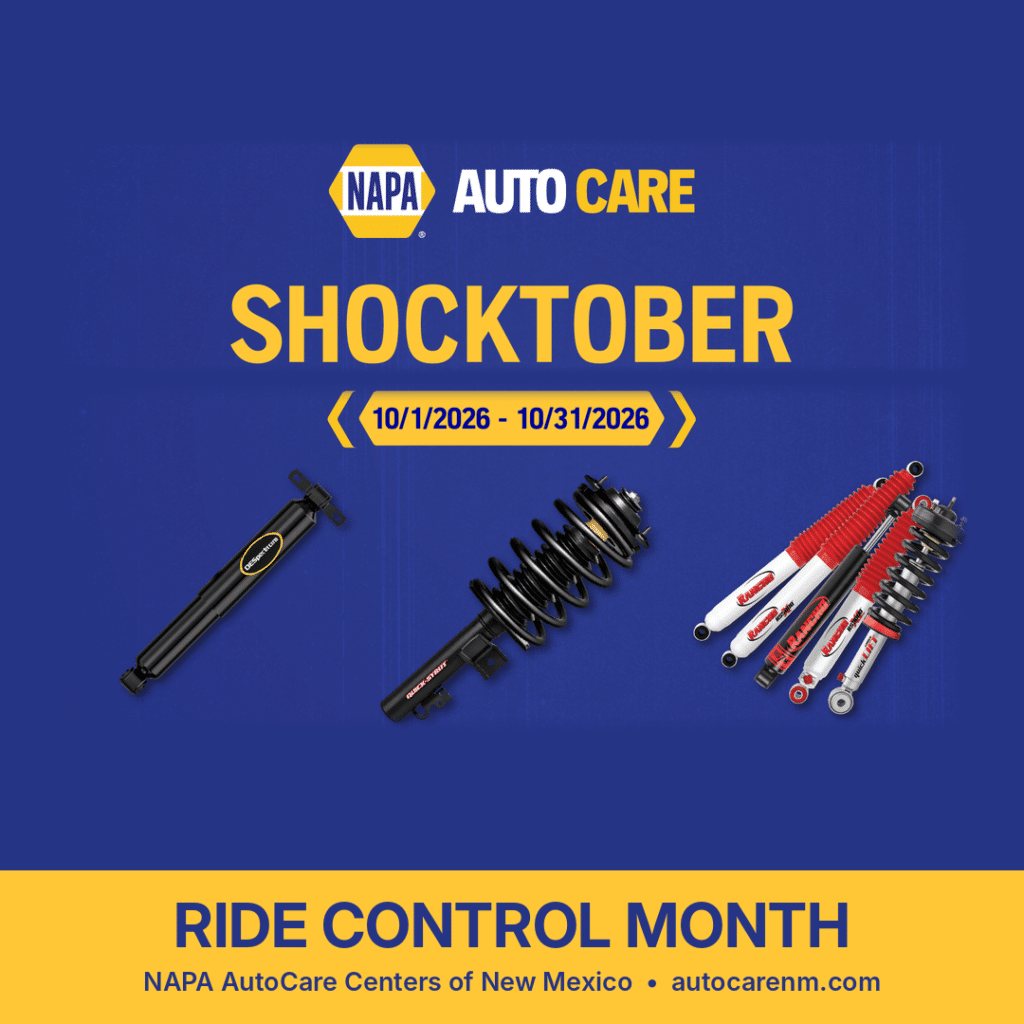
Monsoon season left its mark. The washboard ruts on the way out to the East Mountains are deeper, the arroyos cut new gravel across the county roads, and every pothole in Albuquerque got a little wider in the September rains. Your shocks and struts absorbed all of it, one bump at a time, and they did it so quietly that most of us never noticed the ride getting softer. October is when we ask drivers to notice. Across NAPA AutoCare Centers of New Mexico, we are calling this month Shocktober: thirty-one days focused on the one system on your vehicle that wears out without ever throwing a warning light.
- Shocks and struts lose damping gradually, so the driver adapts without realizing the vehicle has changed.
- New Mexico roads, elevation changes and temperature cycling shorten ride control life compared with national averages.
- A ride control inspection takes about twenty minutes and tells you exactly where you stand before winter driving begins.
What Shocks and Struts Actually Do
Most drivers think of shocks and struts as comfort parts. They are not. Springs hold the vehicle up; shocks and struts control how fast the springs move. Without that control, a spring would keep oscillating after every bump, and the tire would spend part of every second barely touching the road.
That contact is what matters. Your brakes, your steering and your stability control all assume four tires planted on the pavement. When a worn damper lets a wheel hop, the anti-lock braking system sees a tire that is skipping and reacts to it. Steering input gets vague. In an emergency lane change, the body rolls further and recovers slower. Industry testing has shown that worn shocks can add several car lengths to a stopping distance from highway speed. On I-25 at 75 miles per hour, that is the difference between a close call and a claim.
The Slow Fade
Ride control does not fail the way a battery fails. A shock absorber loses its damping force a little at a time, over tens of thousands of miles. Because the change is gradual, your brain recalibrates. The nose dip when you brake at the light on Montgomery feels normal because it has been getting slightly deeper every month. The sway on the Big I ramps feels like the way the truck has always handled.
This is why we tell drivers that the best test is not how the car feels. The best test is how long it has been. Most manufacturers and ride control suppliers suggest an inspection at 50,000 miles and a close look at replacement anywhere beyond that. If you bought your vehicle used and do not know the history, the inspection is worth doing now.
Why New Mexico Is Hard on Ride Control
The Roads
Albuquerque’s surface streets are a patchwork, and the roads outside the metro are worse. Dirt and gravel sections on the way to Placitas, Corrales, the South Valley and the East Mountain deliver thousands of small, fast impacts per mile. That high-frequency pounding is exactly what heats the hydraulic fluid inside a shock and wears the seals and valving.
The Elevation
Driving in New Mexico means climbing and descending constantly. The grade up to Tramway, the long pull on I-40 toward the Sandia crest exits, the drop into the Rio Grande valley from the West Side: every one of those transitions loads and unloads the suspension. Heavier vehicles, which is most of what we drive here, work the dampers hardest.
The Temperature Swings
October brings 40-degree daily swings. A cold morning in the North Valley and a warm afternoon in Rio Rancho means the fluid inside your shocks thins and thickens every day. Seals that have been flexing for 80,000 miles start to seep. If you see a wet film or dirt caked to the lower body of a shock or strut, that is fluid that is no longer doing its job inside.
Signs Worth Paying Attention To
You do not need a lift to pick up the early signals. Here is what we hear from drivers whose inspections turn up worn ride control.
Tire Wear That Does Not Make Sense
Cupping, which looks like scalloped dips around the tread, is the classic sign of a tire bouncing against the road. If your tire shop mentions cupping, the tires are telling you about the shocks.
Nose Dive and Rear Squat
Heavy braking pitches the vehicle forward further than it used to. Pulling away from a stop, the rear sits down. Both mean the dampers are no longer holding the body level through weight transfer.
Drift and Float at Highway Speed
The vehicle feels like it floats over undulations on I-40 west of town, or wanders in crosswinds along the Rio Puerco stretch. Dampers that cannot settle the chassis let the wind move it.
Noise
A knock or clunk over speed bumps often points to worn strut mounts or bushings. Those are part of the assembly, and they wear on the same schedule as the strut itself.
Fluid and Rust
A visual check of each unit tells us a lot. Fluid on the body, pitting on the piston rod or a bent dust shield means replacement is overdue.
What the Inspection Covers
When you bring your vehicle to a NAPA AutoCare Center for a ride control inspection, the technician checks each shock and strut for leakage and physical damage, tests the mounts and bushings, looks at the tires for wear patterns that point to suspension problems, and bounces each corner to feel the rebound. If the vehicle has been in for an alignment recently, they will compare notes, since worn struts throw alignment angles off as the ride height changes.
You get a plain explanation of what they found and what it means. If the dampers are fine, you leave knowing that. If they are not, you get a recommendation and a quote, and the decision is yours.
Why Shops Are Stocked for October
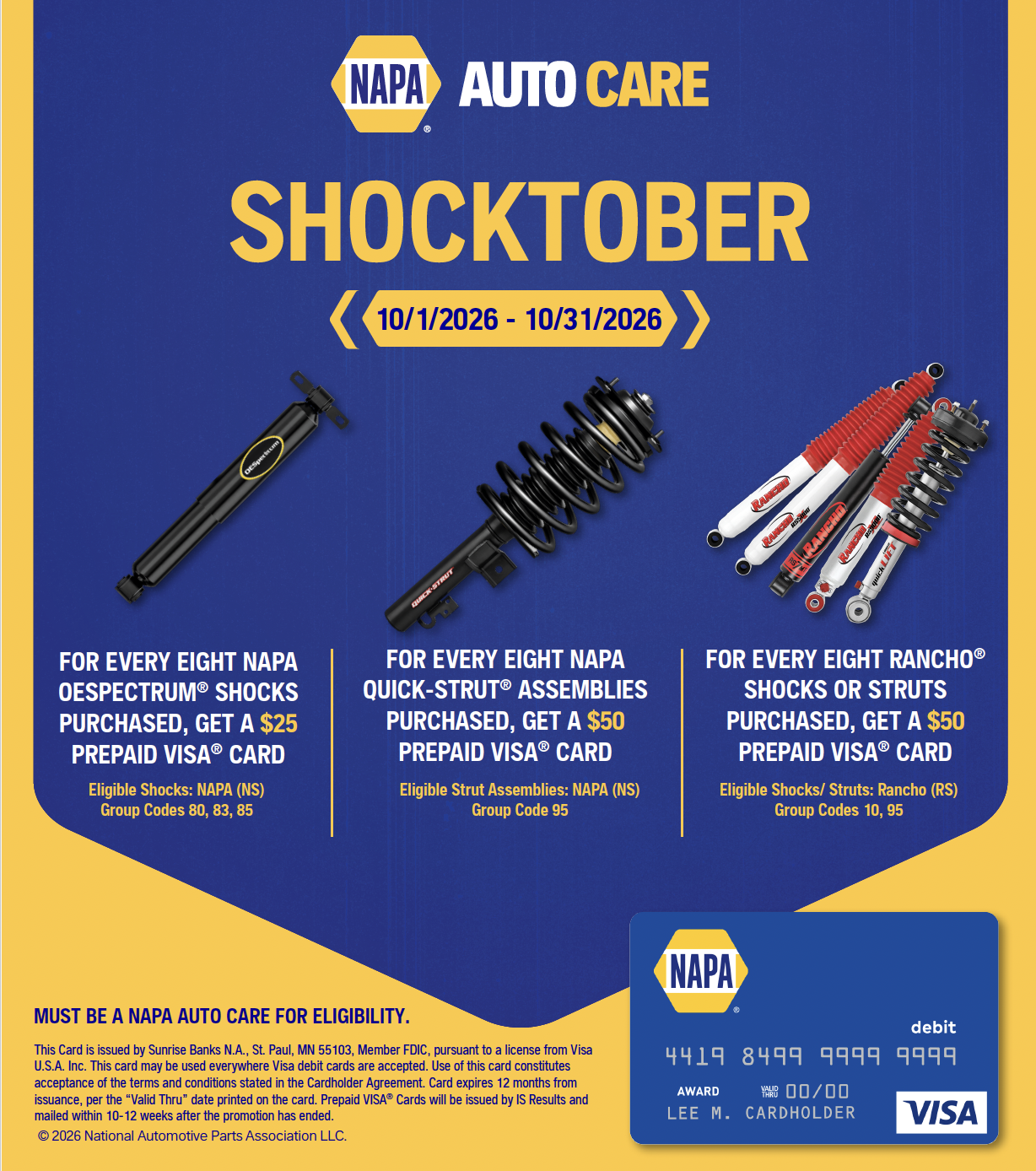
Shocktober is a NAPA Auto Care program, and that is why we are running it now. Through October, member shops across New Mexico are focused on ride control with NAPA OESpectrum shocks, NAPA Quick-Strut complete assemblies and Rancho shocks and struts on the shelf and ready to install. For passenger cars and crossovers, the Quick-Strut assembly replaces the strut, spring, mount and bearing as one unit, which cuts labor time and avoids reusing tired components. For trucks and SUVs that see dirt roads, hunting camps and trailer duty, Rancho is built for the abuse.
Before Winter Arrives
The first hard freeze in Albuquerque usually lands between late October and the middle of November. Ice on the Paseo del Norte bridge, slush on the Big I and black ice on the north-facing grades in the East Mountains all demand tires that stay in contact with the road. Ride control is what keeps them there.
Replacing worn shocks and struts also protects the rest of the vehicle. New dampers extend tire life, hold alignment longer and reduce the pounding on ball joints, tie rods and wheel bearings. The part you cannot see is quietly protecting the parts you pay for later.
Schedule a Ride Control Inspection
Find your nearest NAPA AutoCare Center at autocarenm.com and ask for a Shocktober ride control inspection. Every center in our network is independently owned by people who drive the same roads you do, backed by NAPA parts and the NAPA AutoCare Peace of Mind Warranty. October is the month to find out what 60,000 miles of New Mexico has done to your suspension, before winter does the rest.