
How Your Struts Really Work (And Why New Mexico Roads Wear Them Out Faster)
April 30, 2026
$50 Back on NAPA Brake Parts at Your Neighborhood NAPA AutoCare Center
June 2, 2026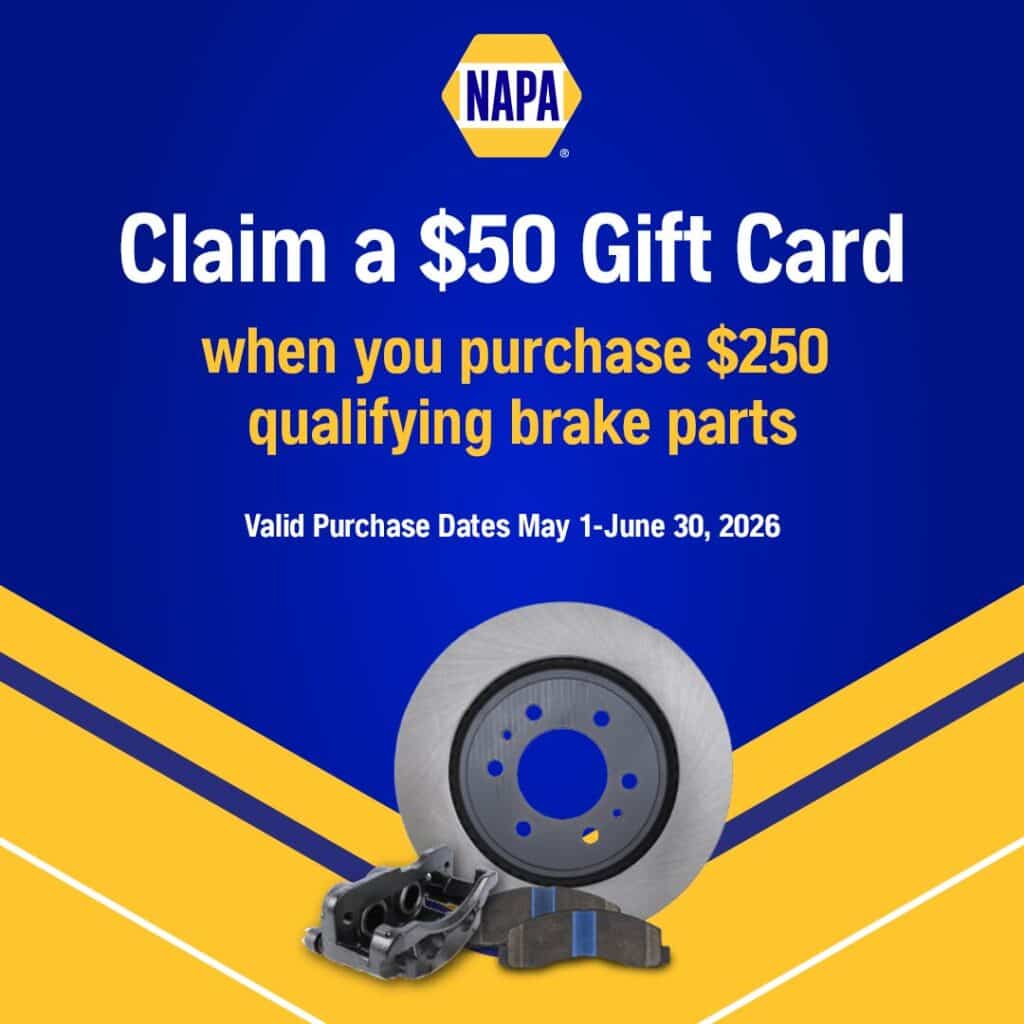
Living and driving in New Mexico puts a unique set of demands on your braking system. Between Albuquerque’s elevation, the temperature swings from Las Cruces to Taos, and the steep grade changes on I-25, US-550, and the climb up to the Sandias, our brakes work harder than most. With gas prices climbing again this spring, every avoided maintenance bill is starting to feel more expensive than the repair it would have prevented. That makes May and June a smart window to take a closer look at what your brakes are actually doing, especially since NAPA is offering a $50 Prepaid Visa Card on $250 in qualifying brake parts through June 30, 2026.
– New Mexico’s altitude, terrain, and heat put harder-than-average wear on brake pads, rotors, and calipers.
– Brake components fail in stages. Catching pad wear early prevents the cascade of damage that turns a routine service into a major repair.
– Qualifying brake service at participating NAPA AutoCare Centers between May 1 and June 30, 2026 may earn you a $50 NAPA prepaid Visa card.
How Elevation and Terrain Punish Your Brakes
Most national service guidance assumes flat highways at sea level. New Mexico drivers don’t get that luxury. Albuquerque sits above 5,000 feet, Santa Fe pushes past 7,000, and a weekend trip to Cloudcroft or the ski valley adds thousands more. Every time you descend one of those grades, your brakes are converting kinetic energy into heat. The thinner air at altitude does less to cool them, so pads and rotors stay hotter for longer than they would in a coastal climate.
Then there’s the surface variety. We move from smooth interstate to washboard county roads to broken city pavement in the same trip. That stop-and-go variation, combined with summer heat radiating off asphalt, creates the kind of repeated thermal cycling that warps rotors and accelerates pad wear. If your vehicle pulls a trailer to the lake, hauls work materials, or carries a full family up Tijeras Canyon on weekends, you are essentially running a high-load brake test every drive.
The Science of Brake Wear
A brake system has three working parts that wear together: the pad, the rotor, and the caliper. The pad is the consumable component, designed to wear down so the rotor doesn’t have to. Once the pad material gets thin enough, the metal backing plate starts grinding directly into the rotor. That is the squealing-turned-grinding sound nobody wants to hear, and it usually means a $40 pad replacement has just turned into a $200 pad-and-rotor job.
Rotors are next in line. They warp from heat, develop scoring from worn pads, and lose thickness over their service life. A warped rotor announces itself with a pulsing brake pedal or a steering wheel that shimmies under braking. Calipers are the longest-lived component, but they are not immortal. Heat cycling can stick the slide pins, corrode the piston seal, or cause uneven pad wear if one pad is dragging while the other is not engaging. The earlier we catch any of these issues, the cheaper the fix.
What Worn Brakes Actually Cost You
A fresh set of pads on a healthy rotor is the least expensive brake service we perform. Wait long enough and that same job grows: rotors get added, then sometimes calipers, then occasionally a brake line or hydraulic component. Beyond the parts, worn brakes also cost you in fuel economy. A dragging caliper or a glazed pad that does not release cleanly forces the engine to work against the brake every mile. At today’s pump prices, that is real money walking out the tailpipe.
There is also the safety calculation, which is harder to put a number on but worth saying out loud. Stopping distance grows quickly as pad material disappears and rotor surfaces glaze. On a New Mexico highway, with summer temperatures pushing tire and brake performance even harder, a few extra feet of stopping distance is the difference between a near-miss and a body-shop estimate.
Symptoms Worth Bringing In
You don’t need to be a technician to know your brakes are asking for attention. The most common signs we see in our shops are a high-pitched squeal at low speeds, a grinding sound under braking, a soft or sinking pedal, vibration through the pedal or steering wheel, the car pulling to one side when you stop, or visibly thin pad material when you look through the spokes of your wheel. Any one of these is worth a quick inspection. Two or more, and we’d rather see your car this week than next month.
Claiming the $50 NAPA Rebate
The current NAPA brake offer is straightforward. Spend $250 or more on qualifying brake parts at a participating NAPA AutoCare Center between May 1 and June 30, 2026, and you can claim a $50 prepaid Visa card. Eligible parts include the full NAPA brake lineup: Adaptive One pads and rotors, SilentGuard pads, ProFormer pads and rotors, StopRite pads, FLEET pads and rotors, NAPA Premium and Gold rotors, Adaptive One calipers, plus Akebono brake pads and Brembo brake pads and rotors.
There is no promo code to remember. Submit your rebate online at NAPARebates.com by July 15, 2026, with a clear copy of your receipt showing the eligible parts. The card is mailed to a U.S. street address and typically arrives within six to eight weeks. The full terms are printed on the rebate page, but the short version is: one rebate per household, original purchases only, and the name on the rebate must match the receipt.
Brakes are not the place where waiting saves money. Schedule an inspection at your nearest NAPA AutoCare Center in New Mexico, and let our technicians tell you exactly where your braking system is in its service life. If you need parts and labor, you may walk out with a $50 rebate on the way.