Shocktober: Why October Is Ride Control Month in New Mexico
October 1, 2026Sunday morning the clocks fell back, and this evening most of New Mexico will drive home in the dark. Sunset in Albuquerque now lands a little after five o’clock, and it keeps sliding earlier until mid-December. For the next five months the commute on I-25, Paseo del Norte, Coors and Tramway happens under headlights. That makes the parts of your car that help you see, and help other drivers see you, the safety system you will use more than any other until spring. This month we are calling it The Dark Season, and we are starting where it starts: with light.
- Plastic headlight lenses haze and yellow under New Mexico’s sun, and a clouded lens can cut usable light on the road dramatically.
- Wiper blades in our climate usually last about a year; summer heat hardens the rubber long before it looks worn.
- A full exterior light check takes 30 seconds, and one dead bulb is the difference between being seen and being missed.
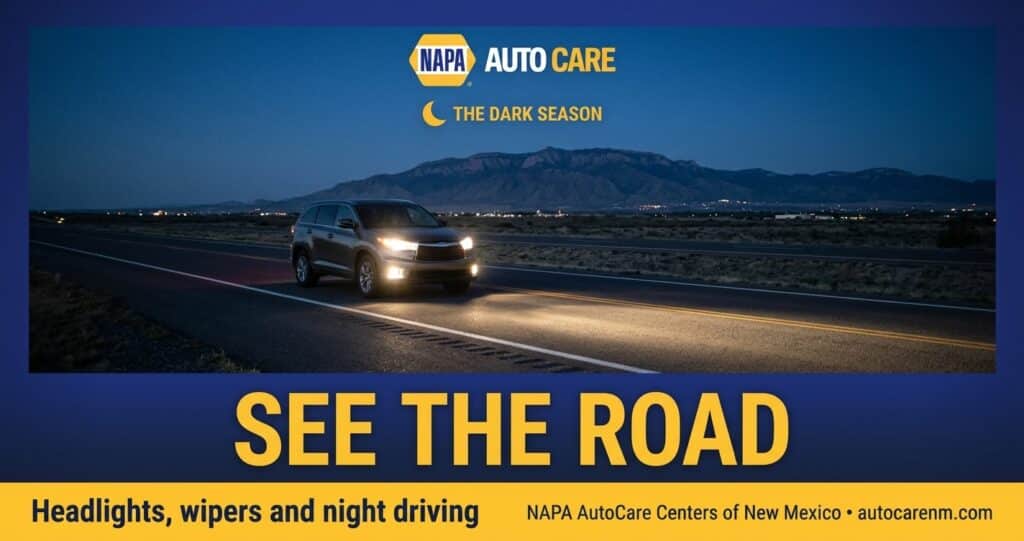
Why the Dark Season Is Harder Here
New Mexico has a reputation for wide-open roads and clear skies, and both work against night drivers in ways people do not expect.
Our long, unlit stretches mean your headlights are often the only light on the road. On I-40 east of Tijeras, on US-550 toward Cuba, or on the frontage roads around Rio Rancho, there are no streetlights to fill in what a weak beam misses. Wildlife moves at dusk, and a deer or an elk standing at the edge of the shoulder shows up only as far as your low beams reach.
Our altitude and dry air mean intense ultraviolet exposure all year. That same sun that bakes a dashboard also yellows headlight lenses and hardens wiper rubber faster than in most of the country.
And our dust is constant. A thin film on the windshield is invisible at noon and turns into glare at night, especially when oncoming headlights hit it.
Headlights: The Three Things That Steal Your Light
Hazed Lenses
Most headlight lenses made in the last 25 years are polycarbonate plastic with a factory protective coating. New Mexico sun breaks that coating down. The lens turns cloudy, then yellow, then pitted, and the light from a perfectly good bulb scatters before it reaches the road. Drivers rarely notice because it happens slowly. Compare your lenses with a new car parked next to you and the difference is obvious.
Restoration is usually the first fix. A proper restoration sands away the damaged layer, polishes the lens clear and seals it with a new UV-resistant coating. The sealing step is what matters. A quick polish without a new coating looks great for a few months and then hazes again, faster than before. If the lens is cracked, crazed on the inside or the housing has moisture in it, replacement is the right answer.
Dim or Mismatched Bulbs
Halogen bulbs dim gradually over their life, often long before they burn out. If one side looks whiter or brighter than the other, the dimmer bulb is near the end. Replace headlight bulbs in pairs so the output and color match. If your vehicle uses HID or LED headlights, a flickering or color-shifted light points to a failing bulb, ballast or driver that a technician should test.
Aim
A headlight aimed too low lights the bumper of the car ahead and leaves you blind beyond it. A headlight aimed too high blinds oncoming drivers. Aim drifts after a minor bump, a lens or bulb replacement, or when the vehicle sits lower than it should. That last one ties back to October: worn springs and struts let the front of the car sag and pitch, and the beam follows. Have the aim checked whenever the lenses are restored or the bulbs replaced.
Wipers and Washer Fluid: Seeing Through the Glass
Blades
Wiper blades are made of rubber, and rubber hates heat and sunlight. By November, blades that went through a New Mexico summer are often hard, cracked or warped even if they look fine sitting still. The tell is how they behave: streaking, skipping, chattering or leaving a haze in the arc. At night, every streak becomes a smear of light when a car comes toward you.
Plan on replacing blades about once a year here, and fall is the right time. Beam-style blades with no exposed frame resist snow and ice buildup better than conventional framed blades. Do not forget the rear wiper on an SUV or hatchback; it is often the most neglected blade on the vehicle.
Washer Fluid
Summer washer fluid and plain water both freeze. Once the valley starts seeing overnight lows in the 20s, water in the reservoir can turn to ice, crack the reservoir or burst a line, and leave you with no way to clear road grime when you need it most. Fill with a winter-rated fluid that is labeled for freezing temperatures. If you have been running water, run the washers until the new fluid comes through the nozzles so the lines are protected too.
Clean the Inside
The inside of the windshield collects a film from vinyl and plastic off-gassing, especially in a car that bakes in the sun. That film turns every oncoming headlight into a starburst. Clean the inside glass with a dedicated glass cleaner and a clean microfiber towel, then buff it dry with a second towel.
Being Seen: The 30-Second Walk-Around
Visibility runs both ways. Once a week through the dark months, start the car, turn on the headlights and walk around it. Check:
- Low beams and high beams
- Front and rear turn signals on both sides
- Brake lights, including the center high-mount light (ask someone to press the pedal, or back up close to a garage door and look for the reflection)
- Reverse lights
- Taillights and side marker lights
- The license plate lamp
That last one is easy to miss and a common reason for a traffic stop. A burned-out brake light is worse: the driver behind you has no warning when you slow down on a dark road.
Habits That Help on Dark Roads
Equipment does most of the work, but a few habits make a real difference.
- Use high beams on empty highways and switch to low beams when you see oncoming headlights or come up behind another vehicle.
- When an oncoming driver’s lights are blinding, look toward the right edge of your lane instead of into the glare.
- Dim the dash. A bright instrument panel and infotainment screen shrink your pupils and make the road ahead look darker.
- Slow down to match your sight distance. If you cannot stop inside the distance your low beams reach, you are driving faster than you can see.
- Watch the shoulders at dawn and dusk, especially in the East Mountains, along the Rio Grande bosque and on rural highways.
What a Shop Checks
During a visibility check at a NAPA AutoCare Center, the technician looks at lens clarity and headlight aim, tests every exterior bulb, inspects wiper blades and arm tension, checks washer pump and nozzle spray, tops off with winter-rated fluid and looks at the windshield for chips or cracks that spread when temperatures swing. It fits easily into an oil change or any other service visit.
If the defroster is slow to clear the glass, mention it. That is next week’s topic: heat, coolant and why your defroster takes forever.
See the Road Until Spring
The Dark Season is long, and it started this week. Clear lenses, bright and aimed headlights, fresh blades and winter washer fluid are some of the least expensive safety upgrades you can make to a vehicle, and they pay off on every drive home until March. Find your nearest NAPA AutoCare Center at autocarenm.com. Every center is independently owned, backed by NAPA parts and the NAPA AutoCare Peace of Mind Warranty, and run by people who drive these same dark roads home.